

In a previous post, I went over Al-Shabaab’s call for women from across East Africa to migrate to Somalia for jihad [i.e make hijrah]. This call was undertaken by one of its Swahili-language magazines, Al-Ghurabaa. In another article, this magazine, specifically geared towards women, also provided a clear and open glorification of female mujahideen, which was meant to help galvanize other women into jihad.
Entitled “Mujahidah [female mujahideen] Leaders,” the article, penned in 2014, extols the virtues of women in jihad, encourages other women to partake in the holy war, and uses Aafia Siddiqui and Samantha Lewthwaite as prime examples of mujahidah for fellow women to emulate. Like the other al-Shabaab article I recently covered, it is unclear how successful the article was in acting as a recruitment vector for the group, but it shows how the group was thinking about women nonetheless.
Like the other article, “Mujahidah Leaders” was written by an anonymous author for Al-Ghurabaa Magazine, itself published by Al-Muhajirun in East Africa. Al-Muhajirun was an ostensible successor to the former al-Hijra organization in Kenya, led by the Kenyan al-Shabaab leader Ahmad Iman Ali. It largely acted as a Swahili-language propaganda machine on behalf of the Somali al-Shabaab, rather than an active group on the ground.
As stated previously, female membership and participation in al-Shabaab has long been researched. Indeed, various studies have documented women performing in many roles for the group in Somalia, including in recruitment, financing, acting as spies, directly taking part in operations, in addition to more monotonous domestic roles in support of husbands or other male fighters. Women in al-Shabaab’s networks across wider East Africa, and especially along the Swahili coast, have also been found to have participated in active, operational roles in said networks.
One of the examples used by Al-Ghurabaa, Samantha Lewthwaite, has herself an infamous history with al-Shabaab. Dubbed the “White Widow” by British media, Lewthwaite was previously married to one of the perpetrators of the July 2005 terrorist attacks in London. Her story after the 7/7 attacks remains murky, though it is believed she remarried another foreign recruit into al-Shabaab, possibly in South Africa, later joining him in East Africa by the early 2010s.
Kenyan authorities have linked her to various attacks and plots across the country, most notably having an alleged support role in al-Shabaab’s 2013 Westgate Mall attack. However, her exact role in the various terrorist attacks she is accused of partaking in has not been confirmed. Her current whereabouts are also unknown, ranging from allegedly living in Uganda, Tanzania, Yemen, or with al-Shabaab militants in Somalia, allegedly leading an all female unit within the group’s amniyat, or intelligence wing. Other reports speculate she may be dead.
At any rate, her red notice listing by INTERPOL remains active, possibly indicating more recent intelligence confirming her alive. And though, to my knowledge, Lewthwaite has never been featured in official al-Shabaab propaganda, such as in releases from al-Kata’ib Media (I could be wrong), the inclusion here clearly acts as a stamp of approval of her by al-Shabaab.
The other woman cited by Al-Ghurabaa, Aafia Siddiqui, dubbed “Lady al-Qaeda’ by the press, is a favorite cause of al-Qaeda and its various branches more broadly. The U.S government accuses Siddiqui of being intimately involved in coordinating with various senior al-Qaeda leaders in Afghanistan in Pakistan in the early 2000s, Khalid Sheikh Muhammad, Ammar al-Baluchi, and others. After her arrest in Afghanistan in 2008, she allegedly attempted to kill her American interrogators.
She was later sentenced to 86 years in prison for this offense. Her case is routinely featured in al-Qaeda propaganda and many of its branches have openly spoken about wanting to free her from imprisonment in the United States. Others have used her case as “evidence” of America’s alleged war on Muslims. In the same vein, al-Shabaab’s propagandists clearly also revered Siddiqui enough to call on women to emulate her.
Moreover, the author makes the case that these two women, Lewthwaite and Siddiqui, have remained steadfast in their convictions, despite slander and imprisonment, respectively. For al-Shabaab, this article, meant to inspire women into jihad, also acts as a call for women who may already be in al-Shabaab’s circles to remain steadfast against any real or perceived hardship. This again shows how deeply al-Shabaab was thinking about women at this time, taking talking points typically made for a male audience and retooling them for women.
And perhaps more interestingly, al-Shabaab’s propaganda has done little to focus on women in recent years. Al-Ghurabaa thus acts as the most recent example of indirect engagement by the group with potential female recruits, even though the magazine stopped publishing a decade ago in 2016. However, it is likely still possible to extrapolate from the magazine to understand how the group may still think in terms of female members and recruits.
Al-Ghurabaa’s article is translated in full from Swahili below. Again, any mistake is my own.
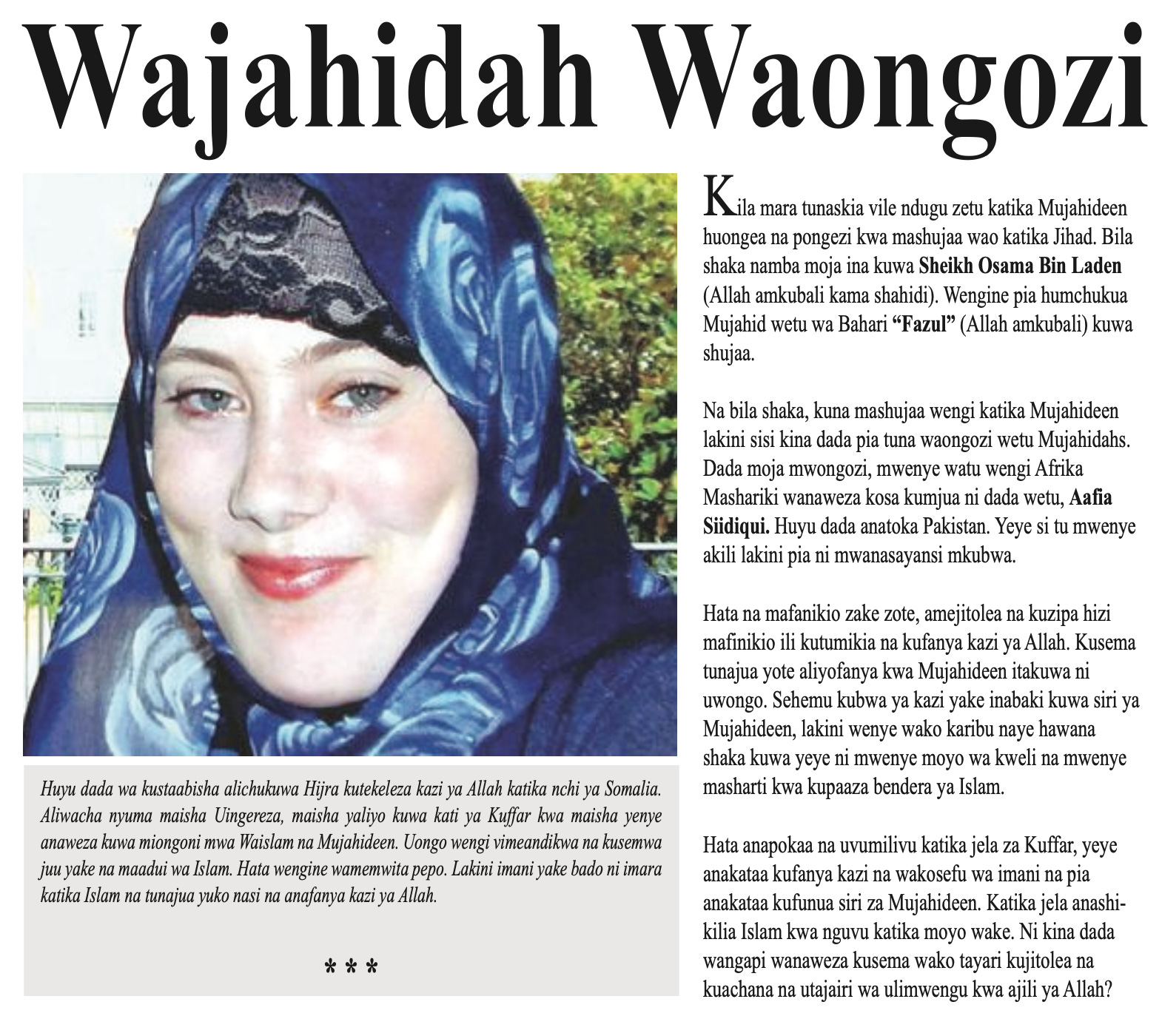
“We hear all the time [how] our brothers in the mujahideen speak with praise for their heroes in Jihad. Certainly, the number one is Sheikh Osama bin Laden (May God Accept Him). Others also consider our mujahid of the sea, Fazul, as a hero. [Fazul refers to Fazul Abdullah Mohammed, or Fazul Harun, the Comorian leader of al-Qaeda’s efforts in East Africa until his death in 2011.]
And certainly, there are other heroes of the mujahideen. But we sisters too have our own leaders of the Mujahidah. One leading sister, whom many in East Africa do not know, is our sister Aafia Siddiqui, a sister from Pakistan. She is not only intelligent, but also a great scientist.
Even with all her success, she has sacrificed and gave up these successes to serve and to work for God. To say we know everything she did for the mujahideen, it would be a lie. Large parts of her work remains a secret of the mujahideen, but those who are close with her do not have doubt that she is one of a true heart and is committed to raising the flag of Islam.
Even as she patiently sits in the jails of the Kuffar, she refuses to work with sinners and refuses to reveal the secrets of the mujahideen. In jail, she holds on to Islam with intensity in her heart. How many sisters can say they are ready to volunteer and to separate from worldly wealth for the path of God?”
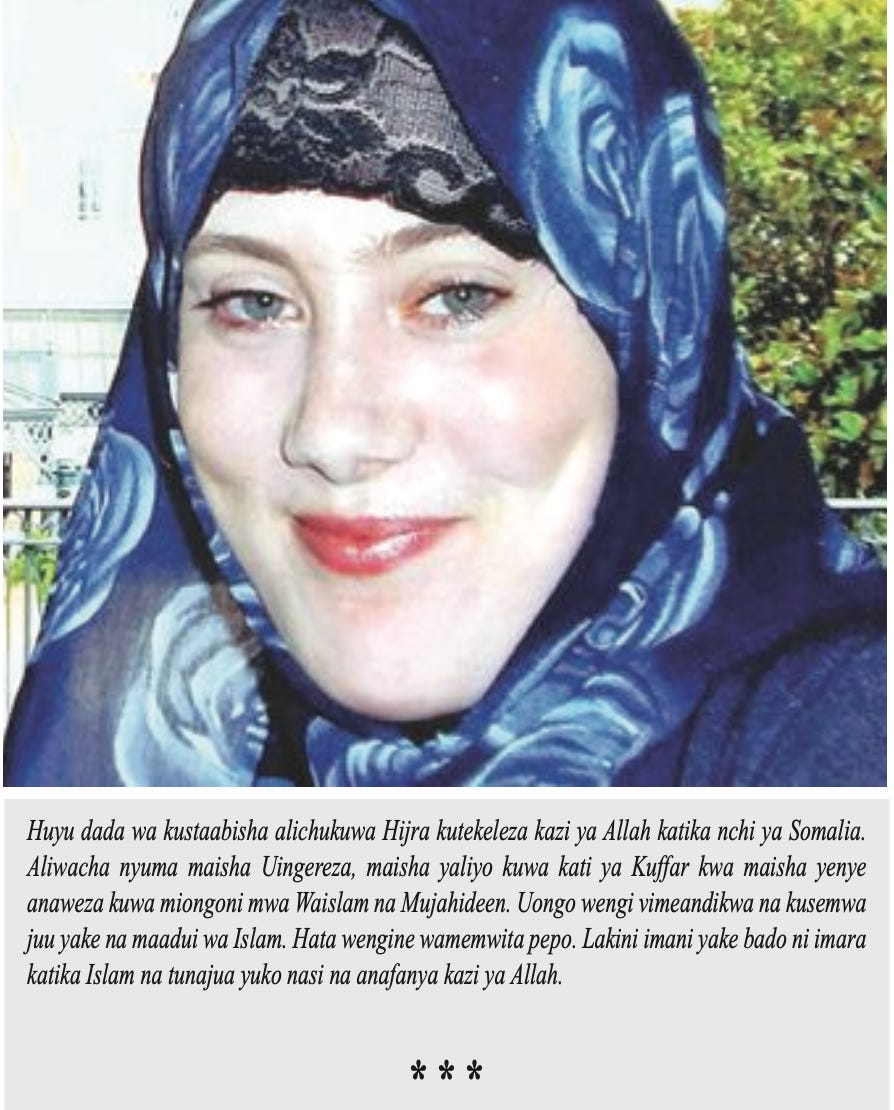
The call out box, which features a photo of Samantha Lewthwaite and identifies her as being in Somalia (though this has always been unconfirmed), is as follows:
“This remarkable sister chose hijrah to implement the work of God in the country of Somalia. She left her home in England, a life among the Kuffar for a life where she can be among Muslims and the Mujahideen. Many lies have been written and spoken about her by the enemies of Islam. Some even called her a demon. But her faith is firm in Islam and we know that she is with us working for God.”
This is part two in a planned series of three posts on Al-Ghurabaa Magazine, offering insights into an overlooked Swahili-language magazine of al-Shabaab. Part one can be found here.